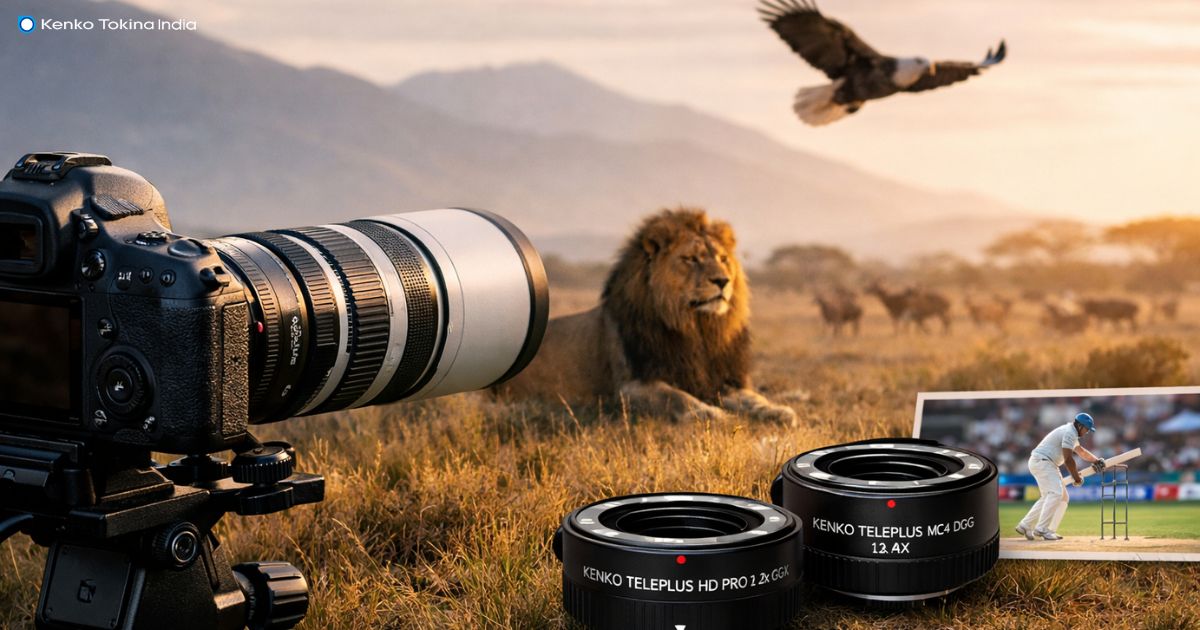
How to Use a Macro Extension Tube to Capture Stunning Close-Up Shots
Learn how to use a macro extension tube to capture sharp, high-magnification close-up shots using your existing lenses. This detailed macro extension tube photography guide explains magnification principles, stacking techniques, exposure control, and an extension tube vs macro lens comparison. Discover practical setup steps, compatibility insights, and expert tips for macro photography with extension tube systems, based on DSLR Series models available at Kenko Tokina India.

Macro photography allows you to record intricate surface textures, fine mechanical details, natural patterns, and miniature subjects with impressive clarity. A macro extension tube offers a technically efficient method to reduce minimum focusing distance and increase subject magnification without introducing additional optical elements.
If you are searching for how to use a macro extension tube, this comprehensive blog provides a structured explanation of working principles, magnification control, exposure behavior, stacking techniques, compatibility considerations, and real-world applications. The information is aligned with DSLR Series products available at Kenko Tokina India.
Introduction to Macro Extension Tubes
A macro extension tube is a hollow mechanical spacer installed between the camera body and the lens mount. Its purpose is to increase the distance between the lens and the sensor plane. This shift changes the lens projection geometry and enables closer focusing.
Since there are no glass elements inside, image quality remains dependent on the original lens. The tube simply modifies the focusing range.
Photographers often choose extension tubes as an accessible entry into macro photography with extension tube setups without investing in a dedicated macro lens.
How a Macro Extension Tube Works
When a lens is moved farther from the sensor, it can focus closer. As focusing distance decreases, subject magnification increases.
Macro Extension Tube Magnification Explained
Magnification is influenced by two primary variables
-
Extension length.
-
Lens focal length.
A simplified formula
Magnification ≈ Extension Length ÷ Focal Length
For example
- 25mm extension on a 50mm lens produces approximately 0.5x magnification.
- 25mm extension on a 100mm lens produces approximately 0.25x magnification.
Shorter focal lengths deliver stronger magnification using the same extension.
Understanding this relationship is fundamental when evaluating magnification potential.
DSLR Series Extension Tubes by Kenko
Kenko Tokina India manufactures DSLR Series extension tubes designed for reliable mounting and electronic communication. These extension tubes for DSLR and mirrorless cameras support electronic signal pass-through, allowing aperture control and autofocus compatibility when supported by the lens.
Common Available Lengths
- 12mm.
- 20mm.
- 36mm.
These can be used individually or combined for higher magnification.
Technical Highlights
Below is a structured overview of DSLR Series specifications
|
Feature |
Specification |
|
Optical Design |
No internal glass elements |
|
Mount Construction |
Metal bayonet |
|
Electronic Contacts |
Full pass-through |
|
Aperture Control |
Camera controlled |
|
Autofocus Support |
Lens dependent |
|
Stackable Configuration |
Yes |
|
Compatibility |
DSLR systems and supported mirrorless adapters |
These characteristics support consistent performance in controlled macro workflows.
Step-by-Step Guide on How to Use a Macro Extension Tube
If you are learning how to use a macro extension tube, follow this technical sequence
Step 1 – Power Off the Camera
Turn off the camera body before attaching the accessory.
Step 2 – Remove the Lens
Detach the lens carefully from the camera mount.
Step 3 – Attach the Extension Tube
Align mount indicators and rotate until locked securely.
Step 4 – Attach the Lens to the Tube
Mount the lens onto the extension tube as you would mount it directly to the camera.
Step 5 – Adjust Camera Settings
- Select aperture priority or manual mode.
- Use an aperture between f8 and f16.
- Increase ISO if light drops.
- Use tripod for stability.
This setup forms a practical extension tube macro setup tutorial for consistent results.
Exposure and Effective Aperture
Increasing extension length reduces light reaching the sensor.
Effective Aperture Formula
Effective f-number = Selected Aperture × (1 + Magnification)
At higher magnification, exposure compensation may be required. Electronic models from Kenko Tokina India maintain communication between lens and camera body for accurate metering.
Depth of Field Considerations
At macro distances, depth of field becomes extremely shallow.
To manage focus precision:
- Stop down the aperture.
- Use focus stacking techniques.
- Stabilize the camera with a tripod.
- Use remote shutter release.
Controlled lighting improves clarity at narrow apertures.
Extension Tube vs Macro Lens Comparison
An extension tube vs macro lens comparison helps determine equipment choice.
Extension Tube
- Uses existing lenses.
- Modular magnification through stacking.
- Lower cost investment.
- Lightweight design.
Dedicated Macro Lens
- Designed for 1:1 magnification.
- Optimized flat-field performance.
- Maintains longer working distance.
Extension tubes provide flexibility for photographers building macro capability incrementally.
Stacking Extension Tube for Higher Magnification
Stacking extension tubes for higher magnification increases total extension length.
Example configuration
12mm + 20mm + 36mm = 68mm extension
Higher extension results in
- Increased magnification.
- Reduced working distance.
- Increased light loss.
- Higher sensitivity to camera movement.
This method supports detailed capture of jewelry, watch mechanisms, textures, insects, and small product elements.
Lens Selection Strategy
Selecting the correct lens improves performance when using an extension tube for macro photography.
Recommended Lens Types
- 50mm prime lens.
- 85mm portrait lens.
- 35mm prime lens.
- 70 to 200mm telephoto lens.
Short focal lengths deliver stronger magnification. Telephoto lenses provide comfortable subject distance.
Close-Up Photography Using Tube Extension
For effective close-up photography using tube extension, follow structured techniques
Focus Technique
- Use manual focus.
- Activate live view magnification.
- Move camera forward or backward for precise focus.
Stability
- Tripod with macro head.
- Mirror lock-up for DSLR.
- Remote trigger.
Lighting
- Ring flash.
- Diffused LED light.
- Off-camera flash with diffuser.
Controlled lighting compensates for exposure reduction caused by extension.
Macro Extension Tube Tips for Beginners
If you are new to close-up work, these macro extension tube tips for beginners provide a practical starting point
- Begin with a single 12mm tube.
- Practice on stationary subjects.
- Observe magnification differences across focal lengths.
- Use stable shooting support.
- Introduce stacking gradually.
Skill refinement improves focus accuracy and framing control.
Choosing the Best Macro Extension Tube for Close-Up Shots
When selecting the best macro extension tube for close-up shots, evaluate
- Camera mount compatibility.
- Electronic communication support.
- Stackable flexibility.
- Build durability.
- Manufacturer reliability.
Kenko Tokina India supplies DSLR Series models engineered with precision mount alignment and stable electronic integration.
For detailed product information and compatibility support, visit Kenko Tokina India through their official website.
Practical Applications
Product Photography
- Jewelry detail capture.
- Watch dial imaging.
- Textile fiber documentation.
- Electronic component inspection.
Nature Photography
- Flower structures.
- Insect details.
- Leaf textures.
- Water droplets.
Extension tubes provide flexibility across studio and outdoor environments.
Frequently Asked Questions
Q.1 What is the working distance when using an extension tube?
Working distance decreases as extension length increases. Telephoto lenses maintain greater distance than wide lenses.
Q.2 Does stacking affect mount safety?
Quality tubes with metal mounts maintain secure alignment when stacked correctly.
Q.3 Can extension tubes be used on mirrorless systems?
Yes, compatible versions or adapters allow integration.
Q.4 Is autofocus reliable?
Autofocus works when electronic contacts are supported by both lens and camera.
Q.5 Is image sharpness reduced?
There are no optical elements inside the tube. Image sharpness depends on the lens used.
Conclusion
A macro extension tube expands close-up capability by mechanically altering lens-to-sensor distance. Understanding magnification ratio, exposure behavior, stacking configuration, and lens selection allows photographers to achieve detailed macro images using existing equipment.
Kenko Tokina India offers DSLR Series extension tubes engineered for reliable mounting and electronic communication. Explore the official range at Kenko Tokina India to build a stable and technically sound macro photography setup.