What Is a C Mount Camera? Uses in Industrial, Machine Vision and Surveillance
This blog explains what a C Mount Camera is and how it supports industrial imaging, machine vision systems, and surveillance installations. It covers mount structure, adapter compatibility, lens integration, and system design considerations. The content also highlights C mount camera applications, optical alignment principles, and professional imaging use cases supported by Kenko Tokina India.
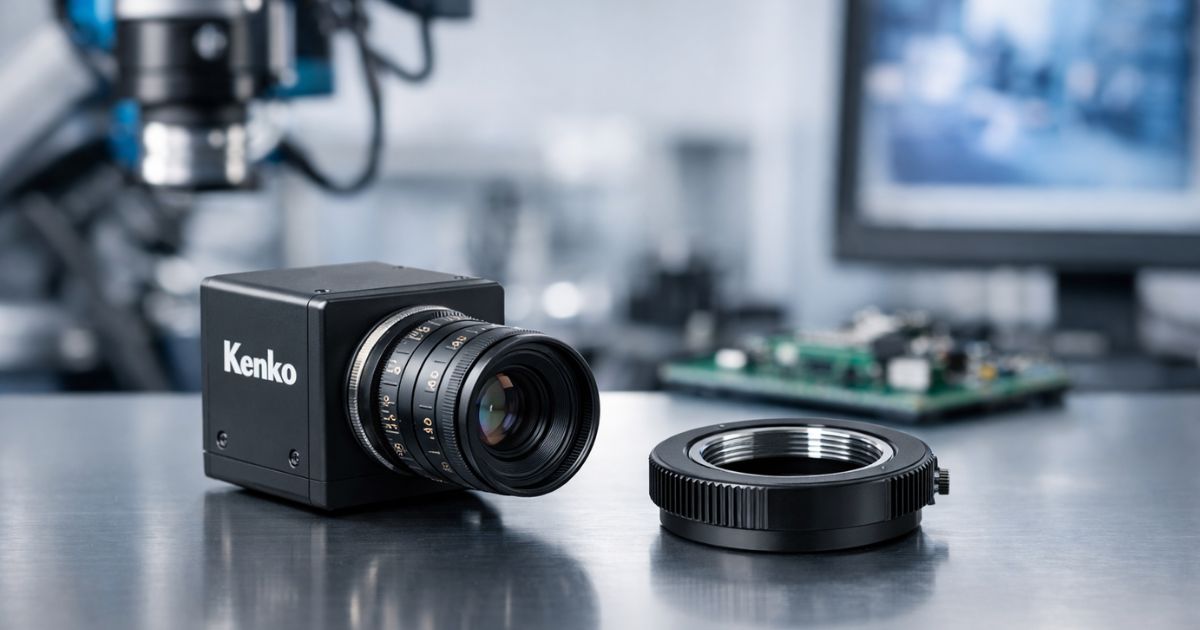
A C Mount Camera is a standardized imaging solution built for environments where optical accuracy, mechanical stability, and repeatable performance define system success. This camera format supports interchangeable lenses through a threaded mount design that allows controlled spacing between the image sensor and optical components. In industrial and technical imaging workflows, this design supports predictable results across long operational cycles.
Industries that rely on automation, inspection, and controlled monitoring adopt C-mount based systems due to their compatibility with precision optics and structured mounting solutions. When paired with high-quality adapters, these cameras deliver stable image capture across demanding imaging conditions.
Mechanical Standard of the C Mount Interface
The C mount interface follows a globally accepted mechanical specification that uses a 1-inch-diameter thread and a fixed flange focal distance of 17.526 mm. This defined spacing plays a major role in maintaining focus accuracy and optical consistency across camera systems.
A C Mount Adapter for Cameras allows the camera body to interface with lenses or optical assemblies designed around this standard. Adapter accuracy influences optical alignment, sensor coverage, and repeatability across installations.
Kenko Tokina India supplies C mount adapters engineered for controlled tolerances and surface stability to support precision imaging workflows.
Optical Alignment and Lens Integration
Correct optical spacing allows lenses to project an image plane accurately onto the sensor surface. Even small deviations in flange depth can impact sharpness, distortion, and focus stability.
A C Mount Lens Adapter maintains optical geometry by preserving the required mechanical distance between lens and sensor. This supports predictable imaging output in applications where manual refocusing or recalibration is not practical.
Optical stability is influenced by:
- Thread concentricity.
- Adapter material rigidity.
- Lens weight support.
- Sensor plane alignment.
These factors directly impact image quality across industrial imaging systems.
Industrial Imaging and Automation Systems
An Industrial C Mount Camera is commonly deployed across automated inspection lines and manufacturing environments where cameras operate continuously. These systems capture structured visual data for defect detection, dimensional analysis, and process verification.
A C Mount Camera for Industrial Imaging supports applications such as:
- Surface inspection of machined parts.
- Assembly verification in production lines.
- Optical alignment in robotic systems.
- Component orientation analysis.
An Industrial Camera with C Mount allows system integrators to select lenses based on working distance, field of view, and magnification without redesigning the camera interface.
Machine Vision Architecture
A Machine Vision C Mount Camera functions as a data acquisition tool rather than a visual display device. These cameras capture images used by software algorithms for decision making and control logic.
A C Mount Camera for Machine Vision integrates into systems that rely on:
- Edge detection.
- Pattern recognition.
- Measurement validation.
- Position correction.
Standardized mounting allows rapid replacement and consistent calibration across multiple production units.
Surveillance and Fixed Monitoring Installations
A C Mount Camera for Surveillance is used in controlled security environments where long focal length lenses or custom optics are required. These installations prioritize image stability and optical reach rather than a compact form factor.
Typical deployment areas include:
- Industrial facility monitoring.
- Infrastructure observation.
- Restricted access zones.
- Traffic and perimeter surveillance.
The rigid mounting structure reduces vibration and maintains focus across fixed installations.
System Design and Integration
C Mount Camera Systems combine cameras, adapters, lenses, and mechanical supports into a unified imaging architecture. System designers value the predictability of the mount when integrating optical components from multiple sources.
This structure supports long-term scalability by allowing lens upgrades or camera replacements without altering mechanical layouts.
Adapter Engineering and Compatibility
A C Mount Adapter for Cameras acts as the mechanical interface that directly influences imaging reliability. Adapter precision determines whether optical spacing remains consistent across operating conditions.
C Mount Adapter Compatibility depends on:
- Accurate flange depth machining.
- Stable thread engagement.
- Material resistance to deformation.
- Controlled surface finish.
Adapters manufactured for professional imaging environments maintain optical spacing even under thermal and mechanical stress.
Lens Compatibility and Sensor Coverage
C Mount Camera Lens Compatibility allows imaging systems to support lenses across different focal lengths and optical designs. This compatibility supports application flexibility while preserving sensor coverage.
Compatible lens types include:
- Fixed focal lenses.
- Macro imaging optics.
- Telecentric lenses.
- Infrared-corrected lenses.
This optical flexibility supports system reuse across multiple projects.
Difference Between C Mount and Cs Mount
The Difference Between C Mount and Cs Mount lies in flange focal distance. CS mount lenses are designed for shorter spacing and cannot directly mount onto C mount cameras without optical spacing correction. C mount lenses can operate on CS-mount cameras using appropriate adapters.
C-mount systems support larger sensors and heavier lenses, making them suitable for industrial imaging tasks.
Professional Imaging Deployments
Professional C Mount Camera Solutions are selected where optical precision, operational uptime, and mechanical reliability determine system performance. These solutions are widely used across research, inspection, and monitoring environments.
Kenko Tokina India supports professional imaging requirements through adapter solutions designed for controlled tolerances and stable optical alignment.
C Mount Camera Applications
C Mount Camera Applications span across:
- Manufacturing quality inspection.
- Scientific imaging setups.
- Security and surveillance systems.
- Automation and robotics.
- Optical measurement platforms.
The standardized mount supports consistent performance across diverse technical requirements.
Technical Highlights
|
Parameter |
Details |
|
Mount Interface |
C mount threaded |
|
Flange Focal Distance |
17.526 mm |
|
Adapter Construction |
Precision machined metal |
|
Lens Compatibility |
Fixed focal and specialty optics |
|
Sensor Support |
Industrial and vision sensors |
|
Deployment Areas |
Industrial, surveillance, automation |
Product Integration from Kenko Tokina India
C mount adapters offered by Kenko Tokina India are engineered to support stable lens mounting and accurate optical spacing. These adapters align with industrial cameras and vision systems that require dependable mechanical interfaces.
System designers seeking reliable optical integration can review C mount adapter solutions from Kenko Tokina India to build imaging systems that support long term operational accuracy.
FAQs
Q.1 What defines a C mount camera?
It uses a standardized threaded interface with controlled optical spacing between lens and sensor.
Q.2 Are C mount cameras suitable for automation?
Yes, the mount supports stable lens integration across automated imaging systems.
Q.3 Do adapters impact image consistency?
Adapter precision directly affects focus accuracy and alignment stability.
Q.4 Can C mount systems support long-term operation?
Yes, rigid mounting and standardized spacing support extended operational use.
For imaging systems that require precision optics and dependable mechanical integration, explore C mount adapter solutions from Kenko Tokina India and build camera systems aligned with industrial accuracy and performance stability.