Are Teleconverters Worth It? Pros, Cons, and Real-World Photography Tips
This detailed guide explores teleconverters, explaining how they extend focal length, how camera teleconverters work, and whether they are a smart investment for wildlife, bird, and sports photography. It compares 1.4x and 2x models, outlines the pros and cons of teleconverters, and includes a practical teleconverters compatibility guide for DSLR users.
Introduction
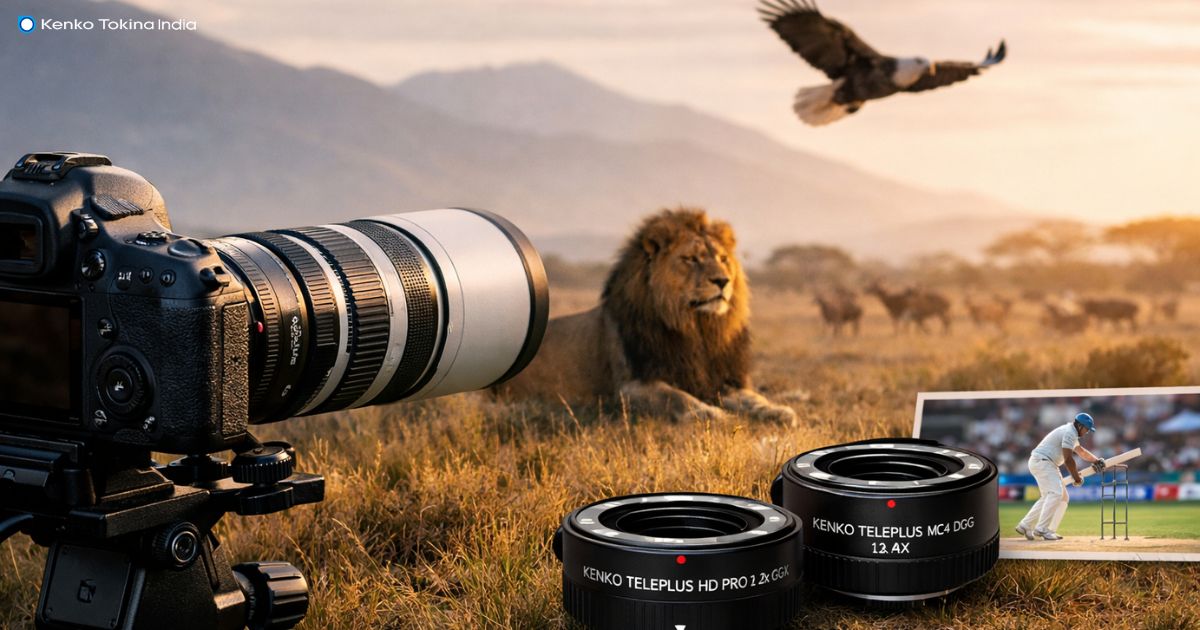
Teleconverters are precision optical accessories designed to extend the focal length of compatible telephoto lenses without increasing physical size. Photographers evaluating long-range performance often ask, are teleconverters worth it for wildlife reserves, bird sanctuaries, motorsports circuits, and field sports coverage.
Modern camera teleconverters integrate advanced optical formulas, multi-layer coatings, and DGX electronic pass-through systems. When matched correctly with fast telephoto lenses, they provide predictable magnification, stable autofocus behavior, and accurate aperture reporting.
This in-depth guide explains how teleconverters work, analyzes the pros and cons of teleconverters, compares models available under Kenko’s lineup, and delivers practical field insights supported by technical evaluation.
Optical Fundamentals – How Teleconverters Work
Understanding how teleconverters work begins with magnification geometry.
A teleconverter mounts between the camera body and lens. It enlarges the projected image circle before it reaches the sensor. The multiplication factor is fixed at either 1.4x or 2x.
Focal Length Conversion Examples
- 200mm lens + 1.4x = 280mm
- 300mm lens + 1.4x = 420mm
- 400mm lens + 2x = 800mm
Aperture Impact
Magnification affects light transmission
- 1.4x reduces maximum aperture by one stop
- 2x reduces maximum aperture by two stops
A 300mm f2.8 lens becomes
- 420mm f4 with 1.4x
- 600mm f5.6 with 2x
This light reduction influences exposure, ISO selection, and autofocus performance. High-grade professional camera teleconverters minimize additional aberrations through precision element alignment and advanced coatings.
Complete Kenko Teleconverter Range
The Kenko lineup distributed through Kenko Tokina India includes four primary models designed for DSLR systems
- TELEPLUS HD Pro 1.4x DGX
- TELEPLUS HD Pro 2x DGX
- TELEPLUS MC4 DGX 1.4x
- TELEPLUS MC7 DGX 2x
Each product serves distinct performance requirements.
TELEPLUS HD Pro 1.4x DGX
- Advanced multi-element optical construction
- Multi-layer anti-reflection coating
- DGX circuitry for accurate EXIF data
- Metal mount interface
- Strong compatibility with fast telephoto primes
This model is widely selected for teleconverters for wildlife photography and field sports coverage.
TELEPLUS HD Pro 2x DGX
- High magnification factor
- Multi-coated optical elements
- Designed for f2.8 telephoto lenses
- Maintains electronic communication
Ideal for aviation photography, distant wildlife, and specialized long-range assignments.
TELEPLUS MC4 DGX 1.4x
- Four-element optical system
- DGX data transmission
- Lightweight construction
- Suitable for enthusiast photographers
A practical choice among the best teleconverters for DSLR users seeking cost-effective reach extension.
TELEPLUS MC7 DGX 2x
- Seven-element configuration
- Enhanced aberration control
- Full aperture data reporting
- Compatible with fast telephoto lenses
Offers extended magnification with improved optical correction compared to entry-level designs.
1.4x vs 2x Teleconverters Comparison
A structured 1.4x vs 2x teleconverters comparison clarifies performance differences.
|
Parameter |
1.4x Models |
2x Models |
|
Magnification |
1.4 times |
2 times |
|
Light Reduction |
1 stop |
2 stops |
|
Autofocus Reliability |
High with f2.8 and f4 lenses |
Strong with f2.8 lenses |
|
Image Sharpness |
Strong central sharpness |
Slight edge softness possible |
|
Recommended Usage |
Wildlife, birds, sports |
Aviation, distant subjects |
Photographers prioritizing autofocus speed and optical balance often select 1.4x models.
Teleconverters Compatibility Guide
A clear teleconverters compatibility guide improves performance consistency.
- Designed for telephoto prime lenses
- Compatible with select telephoto zoom lenses
- Avoid pairing with wide-angle lenses
- Confirm mount type Canon EF or Nikon F
- Check camera autofocus support at effective aperture
DGX integration maintains communication between lens and camera body for accurate exposure metering.
Teleconverters vs Long Lens Comparison
A technical teleconverters vs long lens comparison highlights workflow differences.
Using Teleconverters
- Compact and portable
- Lower financial investment
- Modular compatibility
- Aperture reduction present
Using Native Long Lenses
- Maximum optical resolution
- Strong autofocus performance
- Higher cost
- Greater weight
For photographers expanding focal range without acquiring a 500mm or 600mm lens, teleconverters present a flexible solution.
Teleconverters for Wildlife Photography
Teleconverters for wildlife photography provide additional reach in environments where subject proximity is restricted.
Field Recommendations
- Pair 300mm f2.8 with 1.4x for balanced reach
- Use 400mm f2.8 with 2x in bright daylight
- Maintain shutter speed above 1 divided by effective focal length
- Use monopod support for stability
Fast telephoto lenses retain contrast and autofocus precision after magnification.
Teleconverters for Bird Photography
Small subject size and unpredictable motion demand extended focal length. Teleconverters for bird photography reduce reliance on aggressive cropping.
Technical Practices
- Continuous autofocus tracking
- Center AF priority
- Aperture set between f5.6 and f8
- ISO adjustment based on light reduction
Precise focusing technique preserves feather texture and edge clarity.
Teleconverters for Sports Photography
Large playing fields require extended focal length. Teleconverters for sports photography support tighter framing from fixed positions.
Example
- 70-200mm f2.8 + 1.4x becomes 98-280mm f4
- 300mm f2.8 + 1.4x becomes 420mm f4
These configurations allow coverage across midfield and boundary zones with stable autofocus performance.
Pros and Cons of Teleconverters
A clear evaluation of the pros and cons of teleconverters improves decision-making.
Advantages
- Extends focal length without replacing lens
- Compact accessory
- Cost-efficient telephoto expansion
- Electronic aperture reporting via DGX
- Useful for wildlife, birds, sports
Limitations
- Light reduction
- Autofocus sensitivity influenced by aperture
- Optical performance depends on primary lens
- Limited compatibility with certain zoom designs
Technical Highlights – Full Range
|
Model |
Optical Design |
Magnification |
Coating |
Data Integration |
Mount |
|
HD Pro 1.4x DGX |
Multi-element |
1.4x |
Multi-layer |
DGX electronic |
Canon EF, Nikon F |
|
HD Pro 2x DGX |
Multi-element |
2x |
Multi-layer |
DGX electronic |
Canon EF, Nikon F |
|
MC4 DGX 1.4x |
4 elements |
1.4x |
Multi-coated |
DGX electronic |
Canon EF, Nikon F |
|
MC7 DGX 2x |
7 elements |
2x |
Multi-coated |
DGX electronic |
Canon EF, Nikon F |
All models are engineered for mechanical precision and reliable mount alignment.
Are Teleconverters Worth It for Professional Use
The question are teleconverters worth it depends on shooting requirements.
They deliver strong value when
- Fast telephoto lenses are already owned
- Occasional extended reach is required
- Travel weight must remain controlled
- Budget constraints limit super-telephoto acquisition
Many professionals integrate camera teleconverters into modular lens systems for flexible focal coverage.
Buy Teleconverters Online in India
Photographers planning to buy teleconverters online in India should choose authorized distributors to access genuine products and warranty support.
For technical consultation, mount compatibility guidance, and verified inventory, connect with Kenko Tokina India. Their official range includes HD Pro and MC series models suited for demanding field applications.
Explore product specifications, compare magnification options, and receive expert assistance directly from Kenko Tokina India. For authentic purchasing support and system integration advice, reach out to Kenko Tokina India before finalizing your setup.
Frequently Asked Questions
Q.1 Are teleconverters worth it for wildlife and sports photography?
Yes, teleconverters are worth it for photographers who already own fast telephoto lenses and need extended reach without purchasing a super-telephoto prime. In wildlife reserves and stadium environments, subject distance limits framing flexibility. A high-quality 1.4x or 2x camera teleconverter increases focal length while maintaining electronic communication and exposure accuracy. When paired with f2.8 or f4 lenses, they deliver reliable performance suitable for professional assignments.
Q.2 How do teleconverters work and how do they affect aperture?
Teleconverters mount between the lens and camera body, magnifying the projected image before it reaches the sensor.
-
A 1.4x teleconverter increases focal length by 40 percent and reduces light by one stop.
-
A 2x teleconverter doubles focal length and reduces light by two stops.
For example, a 300mm f2.8 lens becomes 420mm f4 with 1.4x and 600mm f5.6 with 2x. This change affects exposure and autofocus sensitivity depending on camera capability.
Q.3 What is the difference between 1.4x and 2x teleconverters?
The difference lies in magnification, light transmission, and autofocus reliability.
A 1.4x model offers balanced reach with stronger sharpness retention and faster autofocus performance. A 2x model provides maximum reach for distant subjects such as aviation or wildlife, though it reduces light by two stops.
For most field scenarios, 1.4x teleconverters deliver a refined balance between reach and optical clarity.
Q.4 Do teleconverters reduce image quality?
Image quality depends on the base lens and teleconverter design. High-grade professional camera teleconverters with multi-coated optical elements maintain strong central sharpness when paired with premium telephoto primes.
Stopping down the aperture by one stop and using stable support improves contrast and clarity. A 1.4x model typically retains higher image quality compared to 2x magnification.
Q.5 Are teleconverters compatible with all DSLR lenses?
Teleconverters are designed primarily for telephoto prime lenses and selected telephoto zoom lenses. They are not compatible with wide-angle lenses.
Compatibility depends on
-
Mount type such as Canon EF or Nikon F
-
Rear element clearance
-
Effective aperture after magnification
-
Camera autofocus operating limits
Consulting an authorized distributor like Kenko Tokina India ensures correct pairing and warranty-backed purchase.
Q.6 Is it better to use a teleconverter or buy a longer lens?
A teleconverter offers a compact and cost-efficient method of extending focal length across multiple lenses. A native super-telephoto lens delivers maximum optical performance and autofocus speed, though at significantly higher cost and weight.
For photographers seeking flexible telephoto expansion without heavy investment, modern camera teleconverters provide a practical solution for wildlife, bird, and sports photography.
Closing Analysis
Teleconverters offer a technically sound method for extending focal length through optical magnification and electronic integration. From wildlife reserves to stadium sidelines, modern camera teleconverters provide controlled reach expansion with predictable exposure and autofocus behavior.
With proper lens pairing and stabilization technique, they become a reliable extension within a professional imaging workflow. For verified models and expert product support, review the complete teleconverter range available through Kenko Tokina India.